



As a supplier of Factory Delivery Robots, I'm often asked about the sensors these remarkable machines rely on. In this blog post, I'll delve into the key sensors that enable Factory Delivery Robots to navigate, interact, and perform their tasks efficiently within industrial settings.
1. LiDAR Sensors
LiDAR (Light Detection and Ranging) sensors are one of the most critical components of a Factory Delivery Robot. These sensors work by emitting laser beams and measuring the time it takes for the light to bounce back from surrounding objects. By doing so, they create a detailed 3D map of the robot's environment in real - time.
In a factory environment, LiDAR sensors allow the delivery robot to detect obstacles such as machinery, pallets, and even human workers. This helps the robot to plan its path around these obstacles, ensuring smooth and safe navigation. For example, if there is a large piece of equipment blocking the robot's intended route, the LiDAR sensor will detect it, and the robot's onboard software can recalculate a new path to reach its destination.
LiDAR sensors also provide high - resolution data, which is crucial for accurate localization. The robot can use the 3D map created by the LiDAR to determine its exact position within the factory, even in areas with complex layouts. This precision is essential for tasks such as docking at specific stations or picking up and dropping off items at designated locations.
2. Camera Sensors
Camera sensors play a vital role in the operation of Factory Delivery Robots. There are different types of cameras used, including RGB (Red, Green, Blue) cameras and depth cameras.
RGB cameras capture color images of the robot's surroundings. These images can be used for various purposes, such as object recognition. The robot can analyze the visual data from the RGB camera to identify different types of items it needs to pick up or deliver. For instance, it can distinguish between different colored packages or parts based on their visual appearance.
Depth cameras, on the other hand, provide information about the distance between the robot and objects in its field of view. By combining depth information with the color data from RGB cameras, the robot can create a more comprehensive understanding of its environment. This is particularly useful for tasks like grasping objects. The robot can accurately determine the position and orientation of an item, allowing it to pick it up securely.
Moreover, cameras can be used for monitoring the factory floor. They can detect changes in the environment, such as the movement of other robots or the presence of unauthorized personnel. This helps in maintaining a safe and efficient working environment. You can learn more about similar applications in the Hospital Nurse Delivery Robot, which also relies on camera sensors for various tasks.
3. Ultrasonic Sensors
Ultrasonic sensors are relatively simple yet effective sensors used in Factory Delivery Robots. These sensors work by emitting high - frequency sound waves and measuring the time it takes for the waves to bounce back after hitting an object.
Ultrasonic sensors are mainly used for short - range obstacle detection. They are particularly useful for detecting objects that are close to the robot, such as small protrusions or objects at a low height. For example, in a factory where there may be cables or small parts lying on the floor, ultrasonic sensors can help the robot avoid hitting them.
One of the advantages of ultrasonic sensors is their low cost and simplicity. They are easy to integrate into the robot's design and can provide reliable obstacle detection in many situations. However, they have limitations in terms of accuracy and range compared to LiDAR and camera sensors.
4. Inertial Measurement Units (IMUs)
Inertial Measurement Units are essential for the stability and navigation of Factory Delivery Robots. An IMU typically consists of an accelerometer, a gyroscope, and sometimes a magnetometer.
The accelerometer measures the robot's acceleration in different directions. This information is used to determine the robot's speed and changes in its motion. For example, if the robot is accelerating or decelerating, the accelerometer can detect these changes, and the robot's control system can adjust its movement accordingly.
The gyroscope measures the robot's angular velocity, which helps in determining its orientation. By continuously monitoring the gyroscope data, the robot can maintain its balance and stability while moving. This is crucial, especially when the robot is carrying heavy loads or moving on uneven surfaces.
The magnetometer, if present, can provide information about the robot's orientation relative to the Earth's magnetic field. This can be used as an additional reference for navigation, especially in large factories where other localization methods may have limitations.
5. Proximity Sensors
Proximity sensors are used to detect the presence of objects in the immediate vicinity of the robot. There are different types of proximity sensors, such as infrared proximity sensors and capacitive proximity sensors.
Infrared proximity sensors work by emitting infrared light and measuring the amount of light reflected back from an object. They are commonly used for detecting objects at a short distance, such as when the robot is approaching a wall or another robot.
Capacitive proximity sensors detect changes in capacitance caused by the presence of an object. These sensors are particularly useful for detecting non - metallic objects, such as plastic containers or cardboard boxes.
Proximity sensors are often used in combination with other sensors to provide an extra layer of safety. For example, when the robot is docking at a station, proximity sensors can ensure that it stops at the correct distance and does not collide with the docking structure.
6. Force - Torque Sensors
Force - torque sensors are used when the Factory Delivery Robot needs to interact with objects physically. These sensors measure the forces and torques applied to the robot's end - effector, such as a gripper.
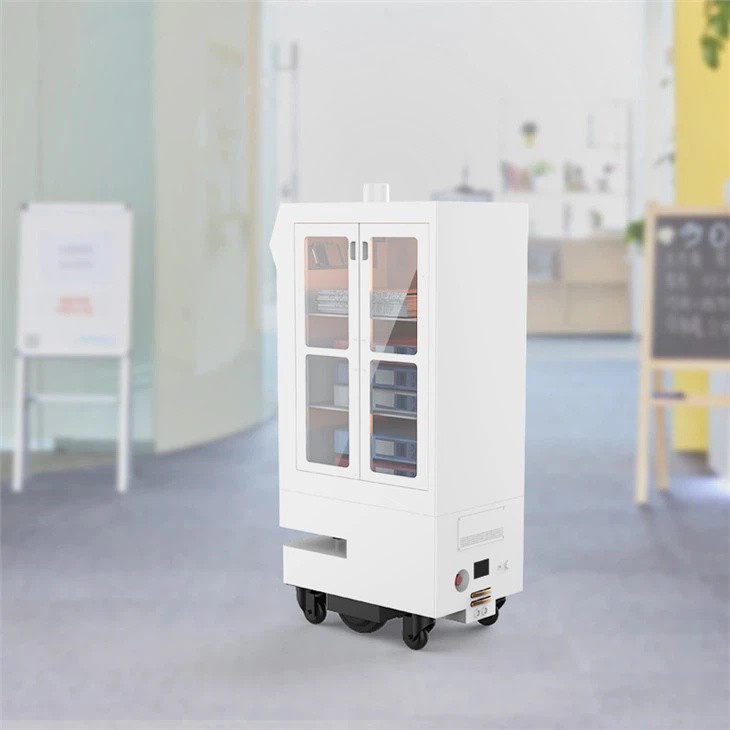

When the robot is picking up an object, the force - torque sensor can detect the amount of force required to grasp the object securely. This helps in preventing the object from slipping or being damaged during the pick - up process. Similarly, when the robot is placing an object down, the sensor can ensure that the object is placed gently and stably.
In some cases, force - torque sensors can also be used for more complex tasks, such as pushing or pulling objects. The robot can adjust the amount of force it applies based on the feedback from the sensor, ensuring that the task is performed efficiently and safely.
Conclusion
The sensors used in Factory Delivery Robots are a complex and integrated system that enables these machines to operate effectively in industrial environments. Each sensor has its unique function, and they work together to provide the robot with the information it needs to navigate, interact with objects, and perform its delivery tasks.
If you're interested in learning more about our Factory Delivery Robots or are considering purchasing them for your factory, we'd be more than happy to have a discussion with you. Our team of experts can provide detailed information about the sensor technology, performance, and customization options of our robots. Whether you're looking to improve the efficiency of your factory operations or enhance workplace safety, our Factory Delivery Robots can be a valuable addition.
References
- "Robotics: Modelling, Planning and Control" by Bruno Siciliano, Lorenzo Sciavicco, Luigi Villani, and Giuseppe Oriolo.
- "Sensors and Actuators for Mechatronics" by David Alciatore and Michael Histand.


