



In the ever - evolving landscape of the restaurant industry, the integration of technology has become a game - changer. One of the most notable advancements is the emergence of restaurant waiter robots. As a supplier of Restaurant Waiter Robots, I am often asked the question: "How fast can a restaurant waiter robot move around the restaurant?" This question is not only crucial for restaurant owners looking to optimize their operations but also for understanding the capabilities and limitations of these innovative machines.
Factors Influencing the Movement Speed of Restaurant Waiter Robots
Safety Considerations
Safety is the top priority in any restaurant environment. A restaurant is a busy place filled with customers, staff, and various obstacles. Restaurant waiter robots need to move at a speed that allows them to avoid collisions with people and objects. For instance, if a robot moves too fast, it may not have enough time to react to a sudden movement of a customer or a dropped item on the floor. Most modern robots are equipped with advanced sensors such as lidar, infrared sensors, and cameras. These sensors detect obstacles in real - time and adjust the robot's speed accordingly. On average, for safety reasons, restaurant waiter robots move at a speed that is comparable to a human walking pace, typically around 1 - 2 meters per second. This speed ensures that the robot can navigate through the restaurant safely while still maintaining an efficient service flow.
Floor Conditions
The condition of the restaurant floor also plays a significant role in determining the speed of the robot. A smooth, flat floor allows the robot to move more quickly and smoothly. In contrast, a floor with uneven surfaces, bumps, or debris can slow down the robot. For example, if a restaurant has a carpeted floor, the robot may need to reduce its speed to ensure stable movement. Some robots are designed to handle different floor types better than others. For instance, robots with larger wheels or more advanced suspension systems can adapt to a wider range of floor conditions and maintain a relatively consistent speed. However, in general, a robot will move slower on a challenging floor surface to prevent slipping or getting stuck.

Load Capacity
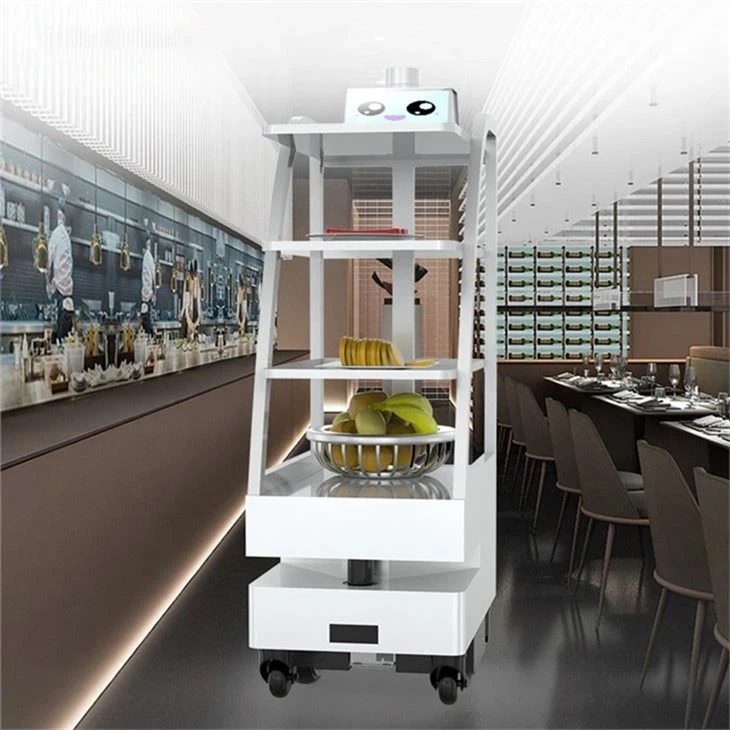
The amount of food or drinks the robot is carrying can impact its movement speed. A robot carrying a heavy load may move more slowly than when it is unloaded. This is because the additional weight requires more power to move and may also affect the robot's balance. Most restaurant waiter robots are designed to handle a certain load capacity, usually ranging from a few kilograms to around 10 - 15 kilograms. When the robot is at its maximum load capacity, it may reduce its speed by about 10 - 20% compared to its unloaded speed. For example, if an unloaded robot moves at 1.5 meters per second, it may slow down to around 1.2 - 1.35 meters per second when fully loaded.
Navigation Complexity
The layout of the restaurant and the complexity of the navigation routes also affect the robot's speed. A restaurant with a simple, open layout allows the robot to move more directly and quickly between tables. On the other hand, a restaurant with a maze - like layout, many partitions, or narrow corridors will force the robot to make more turns and adjustments, thus reducing its overall speed. Some robots are equipped with advanced mapping and navigation algorithms that can optimize the route based on the restaurant layout. However, in a complex environment, the robot may still need to slow down to ensure accurate navigation.
Comparison with Human Waiters
When comparing the speed of restaurant waiter robots with human waiters, it's important to note that each has its own advantages. Human waiters can be more flexible in handling unexpected situations, such as quickly assisting a customer with a special request. However, robots can maintain a consistent speed and work continuously without getting tired. In terms of pure movement speed, as mentioned earlier, robots typically move at a similar pace to human waiters. But robots can be more efficient in terms of route planning. They can use algorithms to calculate the shortest path between tables, which may result in a faster overall service time. For example, in a large restaurant with many tables, a robot can optimize its route to serve multiple tables in the most efficient way, reducing the time spent on unnecessary detours.
Our Restaurant Waiter Robots
As a supplier of Restaurant Waiter Robot, we offer a range of robots that are designed to meet the specific needs of different restaurants. Our Lightning Food Delivery Robot is one of our flagship products. It is equipped with state - of - the - art sensors and navigation systems, allowing it to move quickly and safely through the restaurant. This robot can adapt to various floor conditions and handle different load capacities. It is designed to move at an optimal speed that balances safety and efficiency, ensuring fast and reliable service for your customers.
Our Restaurant Delivery Robot is another popular option. It is specifically designed for large - scale restaurants with complex layouts. This robot uses advanced mapping technology to plan the most efficient routes, even in a crowded environment. It can move at a speed that is comparable to the best human waiters, providing a high - quality service experience.
The Future of Restaurant Waiter Robot Speed
As technology continues to advance, we can expect to see improvements in the speed of restaurant waiter robots. Future robots may be equipped with more powerful motors and better battery technology, allowing them to move faster without sacrificing safety. Additionally, advancements in artificial intelligence and sensor technology will enable robots to make more accurate and rapid decisions, further enhancing their movement speed. For example, robots may be able to predict the movement of customers and adjust their speed and route in real - time, resulting in a more seamless service experience.
Contact Us for Procurement
If you are a restaurant owner or manager looking to enhance your service with the latest restaurant waiter robot technology, we invite you to contact us for procurement discussions. Our team of experts can provide you with detailed information about our products, including their speed capabilities, features, and pricing. We are committed to helping you find the best solution for your restaurant, ensuring that you can provide your customers with a unique and efficient dining experience.
References
- "Robotics in the Service Industry: A Review", Journal of Service Science and Management
- "Safety Standards for Mobile Robots in Public Spaces", International Journal of Robotics Research
- "Optimizing Robot Navigation for Indoor Environments", Proceedings of the IEEE International Conference on Robotics and Automation


