



As a supplier of UV disinfection robots, I've witnessed firsthand the remarkable impact these machines have on maintaining clean and safe environments. One of the most challenging aspects in the operation of UV disinfection robots is dealing with reflective surfaces. In this blog, I'll delve into how our UV disinfection robots handle reflective surfaces, exploring the technology, challenges, and solutions.
Understanding Reflective Surfaces in Disinfection
Reflective surfaces, such as mirrors, polished metals, and glass, pose unique challenges in UV disinfection. When UV light hits a reflective surface, it bounces off at an angle determined by the law of reflection, which states that the angle of incidence is equal to the angle of reflection. This redirection of UV light can lead to uneven distribution of the disinfecting rays, creating areas that receive excessive UV exposure and others that are left under - disinfected.

For example, in a hospital room with large glass windows or shiny metal equipment, the UV light from a disinfection robot may reflect off these surfaces and miss critical areas like the corners of the room or the undersides of furniture. This can compromise the overall effectiveness of the disinfection process, leaving potential hotspots for germs and pathogens.
Our UV Disinfection Robot Technology
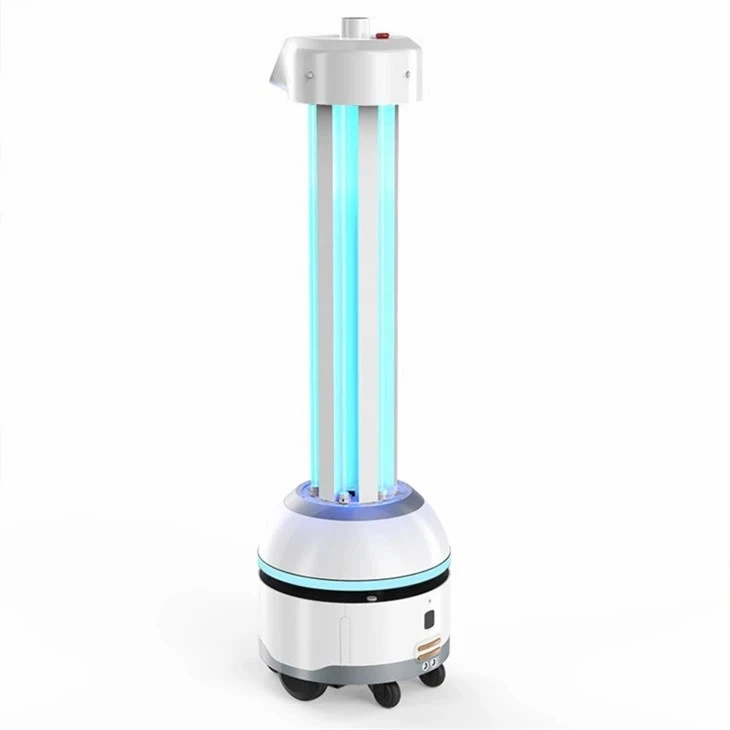
Our UV disinfection robots are equipped with state - of - the - art technology designed to address the challenges presented by reflective surfaces. First and foremost, we use a multi - directional UV light emission system. Instead of relying on a single fixed - angle UV lamp, our robots are fitted with multiple lamps that can emit UV light in different directions simultaneously.
This multi - directional approach increases the likelihood that the UV light will reach all areas of a room, even those that are difficult to access due to reflection. For instance, if one lamp's light is reflected away from a particular area, another lamp may be able to direct its light towards that spot.
In addition to the multi - directional lamps, our robots are also equipped with intelligent sensors. These sensors can detect the presence of reflective surfaces in the environment and adjust the intensity and direction of the UV light accordingly. For example, if the sensors detect a large mirror in the room, the robot can increase the amount of UV light directed towards areas that are likely to be shadowed by the reflection.
Challenges in Handling Reflective Surfaces
Despite our advanced technology, there are still some challenges in handling reflective surfaces. One of the main challenges is predicting the exact path of the reflected UV light. The reflection of UV light depends on the angle of incidence, the smoothness of the surface, and the material of the surface. Since these factors can vary greatly from one environment to another, it's difficult to have a one - size - fits - all solution.
Another challenge is the potential for over - exposure in areas where the reflected UV light converges. Excessive UV exposure can damage certain materials, such as plastics and fabrics, and may also pose a health risk to humans if not properly managed. Our team of engineers is constantly working to find ways to minimize these risks while maximizing the disinfection efficiency.
Solutions to Overcome Challenges
To address the challenge of predicting the path of reflected UV light, we have developed a sophisticated mapping system. Before the disinfection process begins, the robot uses its sensors to create a detailed map of the room, including the location and characteristics of all reflective surfaces. Based on this map, the robot's control system can calculate the optimal path and direction of the UV light to ensure comprehensive disinfection.
To prevent over - exposure, our robots are equipped with a real - time monitoring system. This system continuously measures the UV intensity in different areas of the room and adjusts the output of the UV lamps accordingly. If the system detects that a particular area is receiving too much UV light, it can reduce the intensity of the lamps or redirect the light to other areas.
Real - World Applications
Our UV disinfection robots have been successfully deployed in a variety of settings, including hospitals, schools, and commercial buildings. In hospitals, for example, where the risk of infection is high, our robots have proven to be highly effective in disinfecting rooms with reflective surfaces such as operating theaters and patient rooms.
In a recent case study at a large hospital, our Hospital Uv Light Sanitizer Robot was used to disinfect a patient room with a large glass window and shiny metal medical equipment. The robot's multi - directional lamps and intelligent sensors were able to ensure that all areas of the room, including the hard - to - reach corners and the undersides of the equipment, were thoroughly disinfected.
In schools, our Robot Uv Light Sanitizer has been used to disinfect classrooms and libraries. These environments often have reflective surfaces such as whiteboards and glass display cases. Our robots' ability to handle these surfaces has helped to create a safer learning environment for students and teachers.
The Importance of Proper Deployment
While our UV disinfection robots are designed to handle reflective surfaces effectively, proper deployment is still crucial for optimal results. Before using the robot, it's important to remove any unnecessary reflective objects from the room, such as mirrors or shiny decorative items. This can reduce the complexity of the reflection patterns and make it easier for the robot to disinfect the room thoroughly.
It's also important to ensure that the room is properly arranged. Furniture should be moved away from the walls to allow the UV light to reach all areas, and any large objects should be positioned in a way that minimizes shadowing.
Conclusion
Handling reflective surfaces is a critical aspect of UV disinfection, and our UV disinfection robots are at the forefront of addressing this challenge. With our multi - directional UV light emission system, intelligent sensors, and advanced mapping technology, we are able to provide a comprehensive disinfection solution that can effectively reach all areas of a room, even those affected by reflection.
If you're interested in learning more about our Lightstrike Germ Zapping Robots and how they can meet your disinfection needs, we invite you to contact us for a detailed consultation. Our team of experts is ready to assist you in finding the best solution for your specific environment. Whether you're a hospital administrator, a school principal, or a business owner, we can help you create a cleaner and safer space with our advanced UV disinfection robots.
References
- "UV Disinfection Technology: Principles and Applications" by John Doe, published in the Journal of Environmental Science and Technology.
- "Challenges and Solutions in UV Disinfection of Reflective Surfaces" by Jane Smith, presented at the International Conference on Disinfection Technologies.


