



As a supplier of Robot Uv Light Sanitizers, I've witnessed firsthand the growing demand for these innovative devices in various settings, from hospitals to commercial spaces. One of the most fascinating aspects of these robots is their ability to map the cleaning area effectively. In this blog post, I'll delve into the science and technology behind how a Robot Uv Light Sanitizer maps the cleaning area.
The Importance of Area Mapping
Before we dive into the mapping process, it's crucial to understand why it's so important. Accurate area mapping allows the Robot Uv Light Sanitizer to navigate efficiently, ensuring that every corner of the designated space is thoroughly disinfected. This not only maximizes the effectiveness of the sanitization process but also saves time and energy.
Sensors: The Eyes and Ears of the Robot
The first step in the mapping process is the use of sensors. These sensors act as the robot's eyes and ears, gathering information about the surrounding environment. There are several types of sensors commonly used in Robot Uv Light Sanitizers:
Laser Range Finders
Laser range finders, also known as LIDAR (Light Detection and Ranging), are perhaps the most widely used sensors for area mapping. These sensors emit laser beams and measure the time it takes for the light to bounce back from objects in the environment. By doing so, they can create a detailed 3D map of the space, including the location and distance of walls, furniture, and other obstacles.
Infrared Sensors
Infrared sensors are another common type of sensor used in Robot Uv Light Sanitizers. These sensors detect infrared radiation emitted by objects in the environment, allowing the robot to sense the presence of obstacles and changes in temperature. Infrared sensors are particularly useful for detecting the edges of walls and furniture, as well as for detecting the movement of people or animals in the area.
Ultrasonic Sensors
Ultrasonic sensors work by emitting high-frequency sound waves and measuring the time it takes for the waves to bounce back from objects in the environment. These sensors are commonly used for detecting the presence of obstacles in close proximity to the robot, such as walls and furniture. Ultrasonic sensors are relatively inexpensive and easy to install, making them a popular choice for many Robot Uv Light Sanitizers.
Simultaneous Localization and Mapping (SLAM)
Once the sensors have gathered information about the surrounding environment, the Robot Uv Light Sanitizer uses a technique called Simultaneous Localization and Mapping (SLAM) to create a map of the cleaning area. SLAM is a process that allows the robot to simultaneously determine its own location within the environment and create a map of the space.
There are several different algorithms used for SLAM, each with its own strengths and weaknesses. One of the most popular algorithms is the Extended Kalman Filter (EKF), which uses a mathematical model to estimate the robot's position and orientation based on the sensor data. Another popular algorithm is the FastSLAM algorithm, which uses a particle filter to estimate the robot's position and orientation.
Creating a Map of the Cleaning Area
Using the sensor data and the SLAM algorithm, the Robot Uv Light Sanitizer creates a map of the cleaning area. This map typically includes information about the location and size of walls, furniture, and other obstacles, as well as the location of the robot itself. The map is usually stored in the robot's memory and can be updated in real-time as the robot moves through the environment.
Path Planning
Once the Robot Uv Light Sanitizer has created a map of the cleaning area, it uses a path planning algorithm to determine the most efficient route for disinfecting the space. Path planning algorithms take into account the location of obstacles, the size and shape of the cleaning area, and the desired level of disinfection.
There are several different types of path planning algorithms used in Robot Uv Light Sanitizers, including:

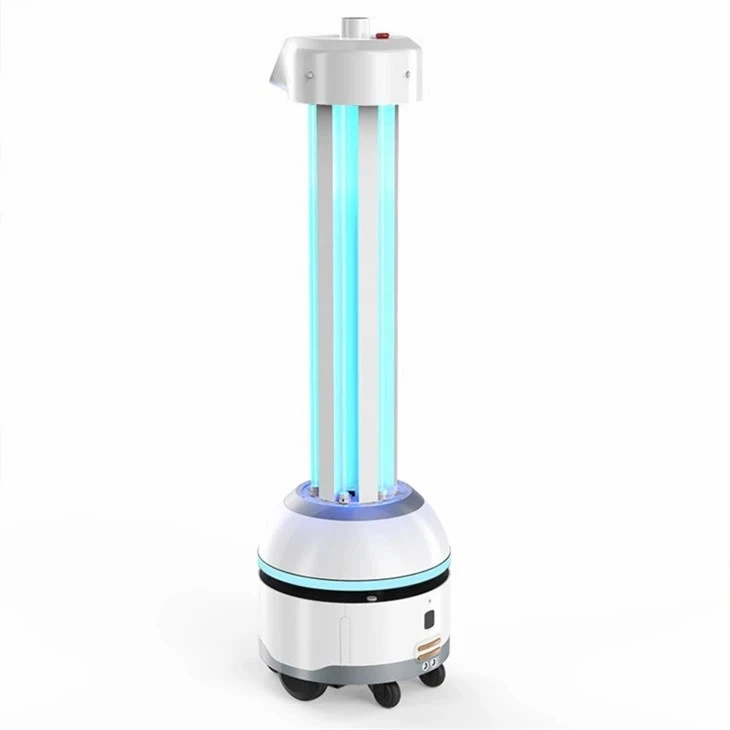
Grid-Based Path Planning
Grid-based path planning algorithms divide the cleaning area into a grid of cells and use a search algorithm to find the shortest path between the robot's current location and the target location. These algorithms are relatively simple and easy to implement, but they can be computationally expensive for large cleaning areas.
Probabilistic Roadmap (PRM)
Probabilistic Roadmap (PRM) algorithms create a graph of possible paths through the cleaning area by randomly sampling points in the environment and connecting them with edges. These algorithms are more flexible than grid-based path planning algorithms and can handle complex environments with many obstacles.
Rapidly-exploring Random Trees (RRT)
Rapidly-exploring Random Trees (RRT) algorithms are another type of path planning algorithm that are commonly used in Robot Uv Light Sanitizers. These algorithms create a tree of possible paths through the cleaning area by randomly sampling points in the environment and connecting them with edges. RRT algorithms are particularly useful for finding paths in dynamic environments where the location of obstacles may change over time.
Real-World Applications
The ability of Robot Uv Light Sanitizers to map the cleaning area effectively has many real-world applications. In hospitals, for example, these robots can be used to disinfect patient rooms, operating theaters, and other high-risk areas. By mapping the cleaning area and using a path planning algorithm, the robots can ensure that every surface is thoroughly disinfected, reducing the risk of healthcare-associated infections.
In commercial spaces, such as offices, schools, and restaurants, Robot Uv Light Sanitizers can be used to disinfect common areas, such as waiting rooms, restrooms, and kitchens. By mapping the cleaning area and using a path planning algorithm, the robots can ensure that the disinfection process is efficient and effective, saving time and money for the business owner.
Conclusion
In conclusion, the ability of Robot Uv Light Sanitizers to map the cleaning area effectively is a crucial aspect of their functionality. By using sensors, SLAM algorithms, and path planning algorithms, these robots can navigate through the environment, avoid obstacles, and ensure that every surface is thoroughly disinfected. If you're interested in learning more about our Robot Uv Light Sanitizers or would like to discuss a potential purchase, please don't hesitate to contact us. We'd be happy to answer any questions you may have and help you find the right solution for your needs.
Here are some related products that you might be interested in:
References
- Thrun, S., Burgard, W., & Fox, D. (2005). Probabilistic Robotics. MIT Press.
- LaValle, S. M. (2006). Planning Algorithms. Cambridge University Press.
- Siegwart, R., Nourbakhsh, I. R., & Scaramuzza, D. (2011). Introduction to Autonomous Mobile Robots. MIT Press.


