



As a supplier of misting disinfection robots, I've witnessed firsthand the growing demand for effective disinfection solutions in various environments. One question that often arises is how these robots perform in high - dust environments. In this blog, I'll delve into the performance of misting disinfection robots under such conditions, exploring their capabilities, challenges, and the solutions we've developed to ensure optimal operation.
Understanding High - Dust Environments
High - dust environments are characterized by a significant presence of airborne particles. These can include industrial settings like mines, construction sites, and manufacturing plants, as well as some public areas during specific events or seasons. The dust particles can vary in size, composition, and concentration, which can have different impacts on the performance of misting disinfection robots.

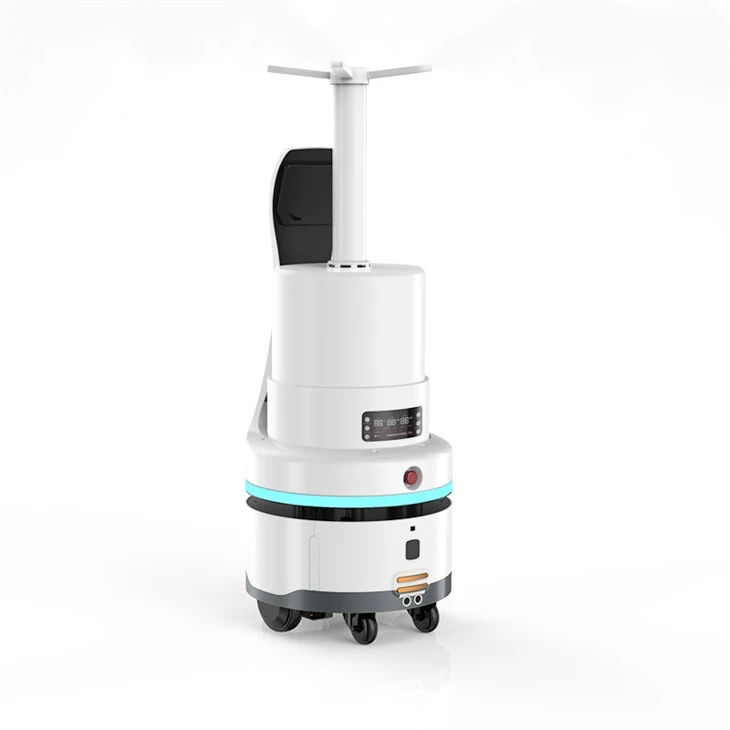
How Misting Disinfection Robots Work
Before discussing their performance in high - dust environments, it's essential to understand how misting disinfection robots operate. These robots are equipped with a tank to hold the disinfectant solution and a spraying system. The spraying system atomizes the disinfectant into fine droplets, which are then dispersed into the air or onto surfaces. The robots are often automated, using sensors and navigation systems to move around the area and cover all necessary spaces.
Performance in High - Dust Environments
Positive Aspects
-
Dust Suppression: One of the unexpected benefits of misting disinfection robots in high - dust environments is their ability to suppress dust. The fine droplets of the disinfectant can capture and weigh down the dust particles, reducing the amount of airborne dust. This not only helps in improving the air quality but also reduces the risk of dust - related health issues for workers in the area.
-
Effective Disinfection: Despite the presence of dust, misting disinfection robots can still perform effective disinfection. The disinfectant droplets can adhere to surfaces and kill harmful microorganisms, even in the presence of a thin layer of dust. The robots' ability to cover large areas quickly and evenly ensures that most surfaces are exposed to the disinfectant.
-
Adaptability: Modern misting disinfection robots are designed with advanced sensors and navigation systems. These features allow them to adapt to different environments, including high - dust areas. The robots can detect obstacles, adjust their paths, and ensure that they cover all areas that need disinfection.
Challenges
- Clogging of Spraying Nozzles: The most significant challenge in high - dust environments is the potential for dust particles to clog the spraying nozzles. When the nozzles are clogged, the atomization of the disinfectant is affected, leading to uneven spraying and reduced disinfection efficiency.
- Sensor Malfunction: The dust can also interfere with the robots' sensors. For example, dust can accumulate on the sensors, causing inaccurate readings. This can lead to navigation errors, missed areas during disinfection, and even collisions with obstacles.
- Reduced Battery Life: The presence of dust can increase the friction on the robot's moving parts, such as wheels and motors. This can lead to increased energy consumption and reduced battery life. As a result, the robot may need to be recharged more frequently, reducing its overall productivity.
Solutions
- Filtering Systems: To prevent nozzle clogging, we have developed advanced filtering systems for our misting disinfection robots. These filters can trap dust particles before they reach the spraying nozzles, ensuring a consistent and even spray of the disinfectant.
- Sensor Protection: We use special coatings and protective covers for the sensors to prevent dust accumulation. Additionally, the sensors are designed to be self - cleaning to some extent, which helps in maintaining their accuracy in high - dust environments.
- Enhanced Battery Management: Our robots are equipped with enhanced battery management systems. These systems can optimize the energy consumption based on the operating conditions, compensating for the increased energy demand in high - dust environments.
Real - World Applications
- Industrial Settings: In industrial settings such as mines and manufacturing plants, our misting disinfection robots have been used to perform regular disinfection while also suppressing dust. The robots can cover large areas quickly, ensuring that the working environment is both clean and safe.
- Construction Sites: Construction sites are often high - dust environments. Our robots can be used to disinfect the construction equipment, temporary offices, and other areas on the site. This helps in preventing the spread of diseases among the workers and also improves the overall air quality.
Our Product Range
We offer a variety of misting disinfection robots suitable for different environments, including high - dust areas. Our Large Indoor Disinfection Robot is designed to cover large indoor spaces efficiently. It has a large disinfectant tank and a powerful spraying system, making it ideal for industrial and commercial settings.
Our Disinfection Robots in Public Places are more compact and can be used in areas such as shopping malls, airports, and hospitals. These robots are designed to be highly maneuverable and can operate in crowded environments.
The Spray Disinfection Robot is another option, which offers a more targeted spraying system. It can be used for disinfection of specific areas or surfaces, such as equipment in a factory or furniture in an office.
Conclusion
Misting disinfection robots can perform well in high - dust environments, offering both dust suppression and effective disinfection. While there are challenges such as nozzle clogging, sensor malfunction, and reduced battery life, we have developed solutions to overcome these issues. Our range of robots is designed to meet the specific needs of different environments, including high - dust areas.
If you're interested in learning more about our misting disinfection robots or would like to discuss a potential purchase, please feel free to reach out. We're here to help you find the best disinfection solution for your needs.
References
- "Advanced Robotics in Industrial and Hazardous Environments" - A research paper on the performance of robots in challenging environments.
- "Disinfection Technologies for High - Risk Areas" - A study on the effectiveness of different disinfection methods in various settings.


