



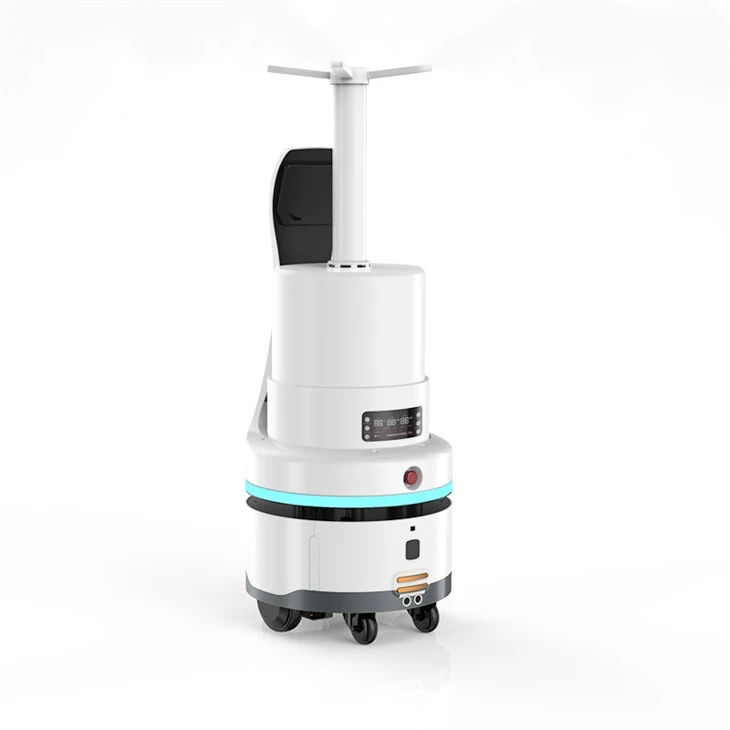
In the era of heightened hygiene awareness, misting disinfection robots have emerged as indispensable tools for maintaining clean and safe environments. As a leading supplier of misting disinfection robots, we understand the critical importance of obstacle detection in ensuring the efficient and safe operation of these robots. In this blog post, we will delve into the fascinating world of obstacle detection technology employed by misting disinfection robots.
The Significance of Obstacle Detection
Before we explore the detection methods, let's first understand why obstacle detection is so crucial for misting disinfection robots. These robots are designed to operate autonomously in various environments, such as hospitals, schools, shopping malls, and offices. During their disinfection tasks, they need to navigate through different spaces filled with furniture, equipment, and people. Without effective obstacle detection, the robots may collide with obstacles, causing damage to themselves, the surrounding objects, or even endangering people nearby. Moreover, collisions can disrupt the disinfection process, leading to incomplete coverage and reduced effectiveness. Therefore, reliable obstacle detection is the foundation for the smooth and efficient operation of misting disinfection robots.

Common Obstacle Detection Technologies
There are several technologies commonly used in misting disinfection robots for obstacle detection. Each technology has its own advantages and limitations, and many robots use a combination of these technologies to achieve more accurate and comprehensive obstacle detection.
1. Ultrasonic Sensors
Ultrasonic sensors are one of the most widely used obstacle detection technologies in robots. These sensors work by emitting ultrasonic waves and measuring the time it takes for the waves to bounce back after hitting an obstacle. Based on the time of flight, the distance between the sensor and the obstacle can be calculated.
The main advantage of ultrasonic sensors is their simplicity and relatively low cost. They can detect obstacles within a certain range, typically up to a few meters. However, ultrasonic sensors have some limitations. They are less accurate in detecting small or thin objects, and their performance can be affected by environmental factors such as temperature and humidity. Additionally, ultrasonic sensors have a relatively narrow field of view, which means they may not be able to detect obstacles in all directions simultaneously.
2. Infrared Sensors
Infrared sensors operate by emitting infrared light and detecting the reflection of the light from an obstacle. Similar to ultrasonic sensors, the distance to the obstacle can be determined based on the intensity and time of the reflected light.
Infrared sensors are also relatively inexpensive and easy to integrate into robots. They are particularly effective in detecting objects at short distances. However, infrared sensors are sensitive to ambient light, which can interfere with their performance. In bright environments, the accuracy of infrared sensors may be reduced. Moreover, like ultrasonic sensors, infrared sensors have a limited field of view.
3. Laser Distance Sensors (LIDAR)
LIDAR (Light Detection and Ranging) is a more advanced obstacle detection technology. It works by emitting laser beams in multiple directions and measuring the time it takes for the beams to return after hitting an obstacle. By rotating the laser scanner, LIDAR can create a 360 - degree map of the surrounding environment, providing detailed information about the position and shape of obstacles.
The main advantage of LIDAR is its high accuracy and wide field of view. It can detect obstacles at long distances and with high precision, making it suitable for complex environments. LIDAR is also capable of creating a real - time map of the environment, which can be used for navigation and path planning. However, LIDAR sensors are relatively expensive, and they consume more power compared to ultrasonic and infrared sensors.
4. Vision Sensors (Cameras)
Vision sensors, such as cameras, are another important component in obstacle detection for misting disinfection robots. Cameras can capture images or videos of the surrounding environment, which can be processed using computer vision algorithms to detect obstacles.
Computer vision algorithms can analyze the color, shape, and texture of objects in the images to identify obstacles. Vision sensors have a wide field of view and can provide rich information about the environment. They are particularly effective in detecting complex objects and distinguishing between different types of obstacles. However, vision - based obstacle detection is highly dependent on lighting conditions. In low - light or highly reflective environments, the performance of vision sensors may be degraded. Additionally, the processing of visual data requires significant computational resources.
How Our Misting Disinfection Robots Combine Detection Technologies
As a supplier of misting disinfection robots, we understand the strengths and weaknesses of each obstacle detection technology. Therefore, our robots are equipped with a combination of these technologies to ensure reliable and accurate obstacle detection.
For example, our Large Indoor Disinfection Robot uses a combination of ultrasonic sensors, LIDAR, and vision sensors. The ultrasonic sensors are used for short - range obstacle detection, providing a quick and simple way to detect nearby objects. The LIDAR sensor creates a detailed 360 - degree map of the environment, allowing the robot to navigate around obstacles with high precision. The vision sensors, on the other hand, are used to detect complex objects and identify different types of obstacles, such as people or furniture.
Our Spray Disinfection Robot also employs a similar multi - sensor approach. By combining different technologies, the robot can adapt to various environments and ensure comprehensive obstacle detection. Whether it is operating in a crowded hospital ward or a large - scale shopping mall, our robots can navigate safely and efficiently.
Obstacle Detection in Public Places
In public places, the environment is often more complex and dynamic compared to indoor spaces. There are more people, moving objects, and irregularly shaped obstacles. Our Disinfection Robots in Public Places are designed to handle these challenges.
The obstacle detection systems in our public - place robots are optimized to detect moving objects, such as pedestrians and vehicles. The vision sensors are used to track the movement of people and predict their trajectories, allowing the robot to avoid collisions. The combination of LIDAR and ultrasonic sensors ensures that the robot can detect both static and dynamic obstacles in real - time.
Conclusion and Call to Action
Obstacle detection is a critical aspect of the operation of misting disinfection robots. By using a combination of advanced technologies, our robots can detect obstacles accurately and navigate safely in various environments. Whether you are looking for a large - scale indoor disinfection solution or a robot for public places, our misting disinfection robots are the ideal choice.
If you are interested in learning more about our misting disinfection robots or would like to discuss a potential purchase, please feel free to contact us. Our team of experts is ready to provide you with detailed information and support to meet your specific needs.
References
- "Robotics: Vision, Control, Sensing, and Intelligence" by Katsushi Ikeuchi
- "Sensors and Actuators for Mechatronics" by J. G. Webster
- Research papers on obstacle detection technologies in robotics from IEEE Xplore


