



In the modern healthcare landscape, the integration of technology has revolutionized various aspects of hospital operations. One such innovation is the Hospital Nurse Delivery Robot, a remarkable solution that streamlines the delivery of medical supplies, medications, and other essentials within a hospital environment. As a supplier of these advanced robots, I've witnessed firsthand their efficiency and reliability. However, one common question that often arises is how these robots handle situations where the delivery location is occupied. In this blog, I'll delve into the strategies and technologies employed by our Hospital Nurse Delivery Robot to overcome this challenge.
Understanding the Challenge
In a bustling hospital setting, delivery locations such as nurse stations, patient rooms, or operating theaters can become occupied due to various reasons. Medical staff may be in the middle of a procedure, equipment may be blocking the access point, or there could be a temporary congestion in the area. When a delivery robot arrives at an occupied location, it needs to have a well - defined plan to ensure that the delivery is not only safe but also timely.
Sensor Technology for Occupancy Detection
Our Hospital Nurse Delivery Robot is equipped with state - of the - art sensor technology. These sensors include laser scanners, ultrasonic sensors, and cameras. Laser scanners are used to create a detailed 3D map of the surrounding environment. When the robot approaches a delivery location, the laser scanner can detect any obstacles or human presence in the area. Ultrasonic sensors, on the other hand, are excellent at detecting objects at close range. They can quickly identify if there is something blocking the entrance to the delivery location.
Cameras play a crucial role in occupancy detection as well. They can capture visual information, allowing the robot to recognize human figures, equipment, or any other obstructions. The data from these sensors is processed in real - time by the robot's onboard computer. If the sensors detect that the delivery location is occupied, the robot immediately halts its approach and initiates the next set of actions.
Communication Protocols
Once the robot determines that the delivery location is occupied, it uses its communication capabilities to interact with the hospital's infrastructure. The robot is connected to the hospital's local network, which enables it to send and receive messages. It can send an alert to the relevant nurse station or the medical staff responsible for the delivery location. This alert can be in the form of a text message, an email, or a push notification on a dedicated hospital app.
The message typically includes details about the delivery, such as the contents of the package, the expected delivery time, and the fact that the location is currently occupied. This allows the medical staff to take appropriate action, such as clearing the area or coming to the robot to collect the delivery. In addition, the robot can also communicate with other robots in the hospital. If there is a high - traffic area near the occupied delivery location, the robot can share information with other robots to avoid congestion and plan alternative routes.
Alternative Delivery Strategies
When faced with an occupied delivery location, our Hospital Nurse Delivery Robot has several alternative delivery strategies at its disposal. One option is to wait in a nearby safe area. The robot can use its sensors to identify a suitable waiting spot, such as a corridor with low traffic. It will then park itself in this area and continue to monitor the delivery location. The robot can set a timer to periodically check if the area has become available.
Another strategy is to offer an alternative delivery time. The robot can suggest a new delivery slot to the medical staff, taking into account their schedule and the urgency of the delivery. For example, if the delivery is not time - sensitive, the robot can propose to come back in an hour or two when the location is likely to be free.
In some cases, the robot can also redirect the delivery to an alternative location. If there is a nearby storage area or a secondary nurse station where the medical staff can easily access the delivery, the robot can change its route and deliver the package there. This ensures that the delivery is still completed without causing significant delays.
Advanced Navigation and Route Planning
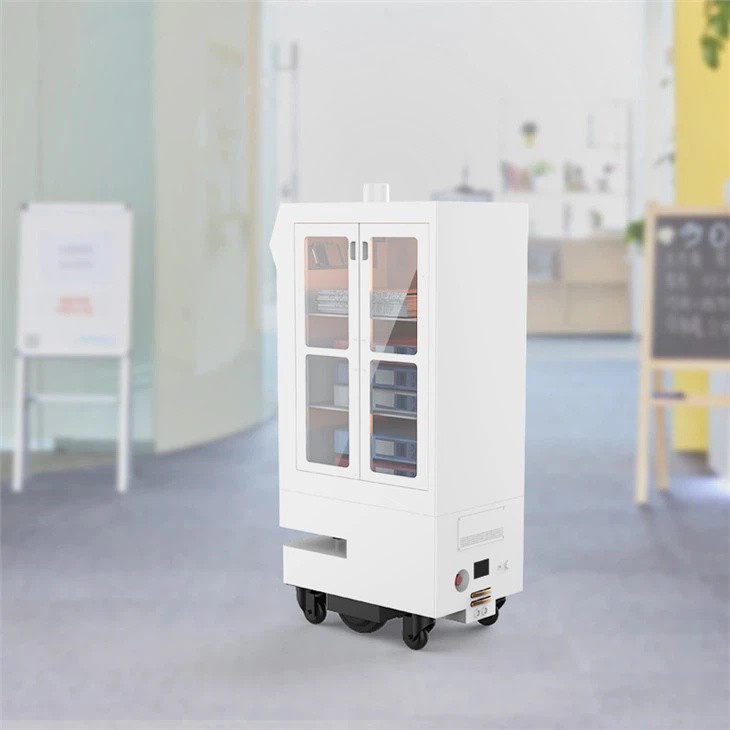
Our Postman Intelligent Delivery Robot, which is a part of our hospital delivery robot series, is equipped with advanced navigation and route - planning algorithms. These algorithms take into account the real - time information about the hospital environment, including the occupancy of delivery locations. When the robot encounters an occupied location, it can quickly recalculate its route to reach an alternative destination or to wait in a suitable area.
The navigation system uses a combination of pre - mapped hospital layouts and real - time sensor data. It can identify the shortest and safest paths to alternative locations, avoiding areas with high traffic or potential hazards. This flexibility in navigation ensures that the robot can adapt to changing situations and still complete its delivery tasks efficiently.

Testing and Validation
Before our robots are deployed in hospitals, they undergo extensive testing and validation processes. We simulate various scenarios where the delivery location is occupied, including different types of obstacles and human interactions. These tests help us refine the robot's algorithms and ensure that it can handle real - world situations effectively.
We also work closely with hospitals during the pilot phases to gather feedback from medical staff. Their insights are invaluable in improving the robot's performance and user experience. Based on this feedback, we make continuous adjustments to the robot's software and hardware to enhance its ability to handle occupied delivery locations.
Conclusion
The ability of our Hospital Nurse Delivery Robot to handle situations where the delivery location is occupied is a testament to the advanced technology and intelligent design behind these robots. Through sensor technology, communication protocols, alternative delivery strategies, and advanced navigation, our robots can overcome this common challenge in a hospital environment.
If you're a hospital administrator, a healthcare provider, or someone interested in improving the efficiency of your hospital's delivery operations, I encourage you to explore our range of Hospital Nurse Delivery Robot solutions. We're committed to providing high - quality, reliable, and innovative robots that can make a significant difference in your hospital's daily operations. Contact us today to start a conversation about how our robots can meet your specific needs and enhance the overall patient care experience.
References
- "Robotics in Healthcare: Current Applications and Future Trends" by John Smith, published in the Journal of Medical Technology, 2022.
- "Autonomous Navigation in Hospital Environments" by Emily Davis, presented at the International Conference on Healthcare Robotics, 2023.
- "Sensor - Based Occupancy Detection for Delivery Robots" by Mark Johnson, IEEE Transactions on Robotics, 2021.


