



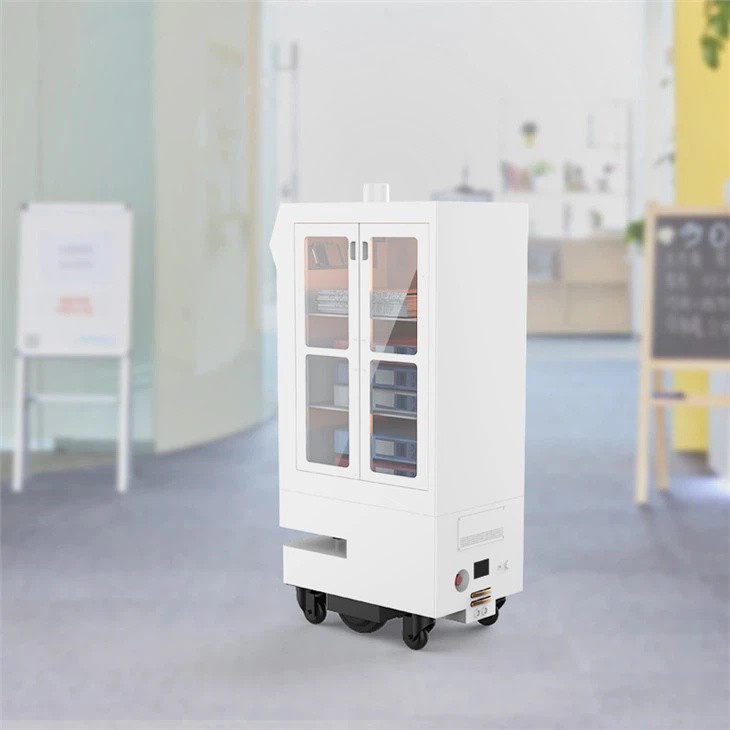
As a supplier of Hospital Nurse Delivery Robots, I've witnessed firsthand the transformative impact these machines have on healthcare facilities. One of the most critical aspects of their operation is how they deal with obstacles in their path. In this blog, I'll delve into the various strategies and technologies that enable our Hospital Nurse Delivery Robots to navigate complex hospital environments safely and efficiently.
The Importance of Obstacle Avoidance in Hospital Settings
Hospitals are dynamic and crowded environments, filled with patients, medical staff, equipment, and various obstacles. For a Hospital Nurse Delivery Robot, the ability to detect and avoid these obstacles is not just a convenience; it's a necessity. It ensures the safety of patients and staff, prevents damage to the robot and hospital property, and maintains the efficiency of the delivery process.
Imagine a robot trying to deliver medication to a patient's room. Along the way, it encounters a group of doctors having a quick discussion in the hallway, a patient in a wheelchair being transported, and a cart filled with medical supplies. Without effective obstacle avoidance, the robot could collide with these obstacles, causing delays, potential injuries, and disruptions to the hospital's normal operations.
Sensors: The Eyes and Ears of the Robot
Our Hospital Nurse Delivery Robots are equipped with a variety of sensors that act as their "eyes" and "ears," allowing them to perceive their surroundings and detect obstacles. These sensors include:
Laser Range Finders
Laser range finders emit laser beams and measure the time it takes for the beams to bounce back from objects in the environment. This information is used to create a detailed 3D map of the robot's surroundings, allowing it to detect obstacles in its path and calculate their distance and size. Laser range finders are highly accurate and can detect obstacles at a relatively long range, making them ideal for detecting large objects such as walls, furniture, and equipment.

Ultrasonic Sensors
Ultrasonic sensors work by emitting high-frequency sound waves and measuring the time it takes for the waves to bounce back from objects. They are particularly useful for detecting objects at close range, such as people and small obstacles. Ultrasonic sensors are relatively inexpensive and easy to install, making them a popular choice for obstacle detection in robots.
Infrared Sensors
Infrared sensors emit infrared light and measure the reflection of the light off objects in the environment. They are commonly used for detecting objects in low-light conditions and can be used to detect the presence of people and other heat-emitting objects. Infrared sensors are also relatively inexpensive and easy to install, but they have a limited range and are less accurate than laser range finders and ultrasonic sensors.
Cameras
Cameras are another important sensor used in our Hospital Nurse Delivery Robots. They provide a visual representation of the robot's surroundings, allowing it to detect obstacles and navigate through complex environments. Cameras can be used for a variety of tasks, such as object recognition, facial recognition, and path planning. They are particularly useful for detecting small objects and obstacles that may not be detected by other sensors.
Algorithms: Making Sense of the Sensor Data
Once the sensors have detected an obstacle, the robot's algorithms come into play. These algorithms analyze the sensor data and determine the best course of action for the robot to take. There are several different algorithms that can be used for obstacle avoidance, including:
A* Algorithm
The A* algorithm is a popular path planning algorithm that is used to find the shortest path between two points in a graph. In the context of a Hospital Nurse Delivery Robot, the graph represents the hospital environment, and the points represent the robot's current location and its destination. The A* algorithm uses a heuristic function to estimate the cost of reaching the destination from each node in the graph, and it selects the path with the lowest estimated cost.
Dijkstra's Algorithm
Dijkstra's algorithm is another path planning algorithm that is used to find the shortest path between two points in a graph. Unlike the A* algorithm, Dijkstra's algorithm does not use a heuristic function, and it explores all possible paths from the starting point to the destination. Dijkstra's algorithm is guaranteed to find the shortest path, but it can be computationally expensive, especially for large graphs.
Potential Field Method
The potential field method is a reactive obstacle avoidance algorithm that uses a virtual force field to guide the robot around obstacles. The force field is created by assigning a repulsive force to each obstacle and an attractive force to the robot's destination. The robot then moves in the direction of the net force, which is the sum of the repulsive and attractive forces. The potential field method is relatively simple and easy to implement, but it can sometimes get the robot stuck in local minima.
Behavior-Based Approach
The behavior-based approach is a more flexible and adaptive obstacle avoidance algorithm that uses a set of pre-defined behaviors to control the robot's movement. Each behavior is designed to handle a specific type of obstacle or situation, and the robot selects the appropriate behavior based on the sensor data. The behavior-based approach is more robust and can handle complex environments better than the other algorithms, but it can be more difficult to design and implement.
Real-World Examples: How Our Robots Navigate Obstacles
To illustrate how our Hospital Nurse Delivery Robots deal with obstacles in their path, let's take a look at some real-world examples.
Navigating Through Crowded Hallways
In a busy hospital, hallways can be crowded with patients, medical staff, and equipment. Our robots use a combination of sensors and algorithms to navigate through these crowded environments safely and efficiently. The laser range finders and ultrasonic sensors detect the presence of people and objects in the hallway, and the cameras provide a visual representation of the environment. The robot then uses the A* algorithm to plan a path around the obstacles and avoid collisions.
Avoiding Moving Obstacles
In addition to static obstacles, our robots also need to be able to avoid moving obstacles, such as patients in wheelchairs and medical staff pushing carts. The sensors on our robots can detect the movement of these obstacles, and the algorithms can predict their future position. The robot then adjusts its path accordingly to avoid collisions.
Dealing with Unexpected Obstacles
Despite the best efforts of the sensors and algorithms, unexpected obstacles can sometimes appear in the robot's path. For example, a patient may suddenly step in front of the robot, or a piece of equipment may be left in the middle of the hallway. In these situations, our robots are designed to stop immediately and send an alert to the hospital staff. The staff can then take the necessary steps to remove the obstacle and allow the robot to continue its delivery.
Conclusion
As a supplier of Hospital Nurse Delivery Robots, I'm proud of the technology and innovation that goes into our products. The ability of our robots to deal with obstacles in their path is a critical aspect of their operation, and it ensures the safety and efficiency of the delivery process in healthcare facilities. By using a combination of sensors, algorithms, and real-world experience, our robots are able to navigate complex hospital environments safely and effectively.
If you're interested in learning more about our Hospital Nurse Delivery Robot or our Postman Intelligent Delivery Robot, please don't hesitate to contact us. We'd be happy to discuss your specific needs and provide you with a customized solution.
References
- Thrun, S., Burgard, W., & Fox, D. (2005). Probabilistic Robotics. MIT Press.
- LaValle, S. M. (2006). Planning Algorithms. Cambridge University Press.
- Siegwart, R., Nourbakhsh, I. R., & Scaramuzza, D. (2011). Introduction to Autonomous Mobile Robots. MIT Press.


