



As a provider of food delivery robots, I've witnessed firsthand the remarkable advancements in this technology and the challenges it faces, particularly in crowded areas. In this blog post, I'll delve into how our food delivery robots are designed to navigate through bustling streets, busy sidewalks, and congested public spaces, ensuring efficient and reliable food delivery.
Sensor Technology: The Eyes and Ears of the Robot
At the heart of our food delivery robots' ability to handle crowded areas lies their sophisticated sensor technology. These robots are equipped with a combination of lidar, cameras, ultrasonic sensors, and infrared sensors, which work together to create a detailed and real - time map of their surroundings.
Lidar sensors emit laser beams and measure the time it takes for the light to bounce back, creating a 3D point cloud of the environment. This allows the robot to accurately detect obstacles, including pedestrians, cyclists, and other vehicles, even in low - light conditions. Cameras provide visual information, enabling the robot to recognize traffic signs, crosswalks, and other important visual cues. Ultrasonic sensors are used for short - range detection, helping the robot to avoid collisions with nearby objects, while infrared sensors can detect heat sources, such as people, in the vicinity.
By integrating data from multiple sensors, our robots can build a comprehensive understanding of the environment, allowing them to make informed decisions about their path and speed. For example, if the sensors detect a large group of pedestrians crossing the street, the robot can slow down or stop and wait for them to pass before proceeding.
Advanced Navigation Algorithms
In addition to sensor technology, our food delivery robots are powered by advanced navigation algorithms. These algorithms use the sensor data to plan the most efficient route to the delivery destination, taking into account factors such as traffic conditions, pedestrian density, and road rules.
One of the key features of our navigation algorithms is the ability to adapt to dynamic environments. In crowded areas, the situation can change rapidly, with new obstacles appearing and disappearing constantly. Our algorithms are designed to continuously update the robot's path in real - time, ensuring that it can avoid obstacles and reach the destination as quickly as possible.
For instance, if a sudden construction site blocks the original route, the algorithm can quickly calculate an alternative path, taking into account the new obstacles and traffic flow. This adaptability is crucial for ensuring reliable food delivery in crowded urban areas.
Human - Robot Interaction
Another important aspect of handling crowded areas is the ability of our robots to interact safely and effectively with humans. Our food delivery robots are designed with a friendly and approachable appearance, which helps to reduce people's concerns about interacting with them.
The robots are also equipped with communication devices, such as speakers and displays, which allow them to communicate with pedestrians and other road users. For example, if the robot needs to pass through a narrow space where pedestrians are standing, it can use its speaker to announce its presence and ask for permission to pass. The display can show messages such as "Please stand clear" or "I'm making a delivery," providing clear instructions to people in the vicinity.
In addition, our robots are programmed to follow social norms and rules of etiquette. They will give way to pedestrians, wait patiently at crosswalks, and avoid making sudden or unexpected movements that could startle people. This human - centered design approach helps to ensure that the robots can operate safely and smoothly in crowded areas.
Case Studies: Real - World Performance
To illustrate the effectiveness of our food delivery robots in crowded areas, let's take a look at some real - world case studies.
In a busy downtown area, our Restaurant Delivery Robot was deployed to make deliveries to nearby offices and apartments. Despite the high volume of foot traffic, the robot was able to navigate through the streets with ease, using its sensor technology and navigation algorithms to avoid collisions and find the most efficient routes. The robot's friendly appearance and communication capabilities also helped it to interact positively with pedestrians, who often stopped to take pictures or ask questions about the technology.
In another case, our Lightning Food Delivery Robot was used to make deliveries in a crowded shopping mall. The robot was able to move through the busy corridors, avoiding shoppers and other obstacles. It used its short - range sensors to detect people who were standing too close and adjusted its speed and path accordingly. The robot's ability to operate in such a dynamic and crowded environment demonstrated its robustness and adaptability.

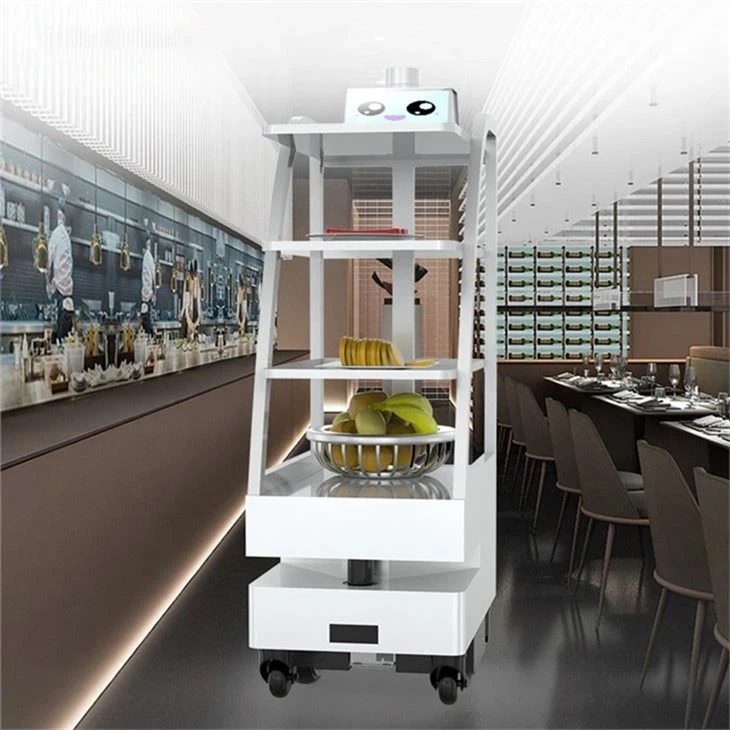
Our Restaurant Fast Food Delivery Robot has also been successful in delivering food in areas with heavy traffic. It can accurately detect traffic lights, stop signs, and other road markings, and follow the rules of the road. When faced with congested traffic, the robot can choose alternative routes or wait patiently until the traffic clears, ensuring that the food is delivered fresh and on time.
Future Developments
As technology continues to evolve, we are constantly working on improving the performance of our food delivery robots in crowded areas. One area of focus is the development of more advanced sensor technology. For example, we are exploring the use of high - resolution cameras and more powerful lidar sensors, which can provide even more detailed information about the environment.
We are also looking into enhancing the human - robot interaction capabilities of our robots. This could include the development of more natural language processing algorithms, allowing the robots to have more in - depth conversations with people. Additionally, we are working on improving the robot's ability to understand and respond to social cues, such as body language and facial expressions.
Contact Us for Purchase and Collaboration
If you are a restaurant owner, a food delivery service provider, or simply interested in the future of food delivery technology, we invite you to contact us for more information about our food delivery robots. Our team of experts is ready to discuss your specific needs and requirements and provide you with a customized solution. Whether you need a single robot for a small - scale operation or a fleet of robots for a large - scale delivery service, we have the products and expertise to meet your demands.
References
- "Autonomous Mobile Robots: Navigation and Control" by Roland Siegwart, Illah Nourbakhsh, and Davide Scaramuzza.
- "Robotics: Modelling, Planning and Control" by Bruno Siciliano, Lorenzo Sciavicco, Luigi Villani, and Giuseppe Oriolo.
- Research papers on sensor fusion and navigation algorithms in robotics from IEEE Transactions on Robotics and other leading academic journals.


