



In the ever - evolving landscape of the restaurant industry, technological advancements have introduced a new player: restaurant waiter robots. As a supplier of Restaurant Waiter Robots, I've been closely following the industry's reception and the practical challenges these robots face. One of the most common questions we encounter is whether these robots are capable of working in a restaurant filled with a lot of obstacles.
The Rise of Restaurant Waiter Robots
The demand for restaurant waiter robots has been on the rise in recent years. With labor shortages becoming a significant issue in the food service sector, many restaurant owners are turning to automation to streamline their operations. These robots offer several advantages, such as increased efficiency, reduced human error, and the ability to work around the clock.
Our Restaurant Delivery Robot is designed to navigate through the restaurant environment, delivering food and drinks to the tables. It can handle multiple orders at once, ensuring that customers receive their meals in a timely manner. Similarly, the Restaurant Fast Food Delivery Robot is tailored for fast - paced fast - food restaurants, where speed is of the essence. And the Lightning Food Delivery Robot is engineered to provide rapid delivery, making it ideal for busy dining establishments.
Obstacles in a Restaurant Environment
Restaurants are complex environments filled with various obstacles. These can include tables, chairs, customers moving around, waitstaff rushing to serve, and even spilled food or drinks on the floor. All these elements pose challenges for the smooth operation of waiter robots.
Tables and chairs are fixed obstacles that are relatively easy to map. However, their arrangement can change during peak hours as staff may need to reconfigure the seating to accommodate more customers. This means that the robot's navigation system needs to be flexible enough to adapt to these changes.
Customers are another significant source of obstacles. They may suddenly stand up, move their chairs, or even wander into the robot's path. Unlike fixed obstacles, customers are unpredictable, and the robot needs to be able to detect and react to their movements in real - time.
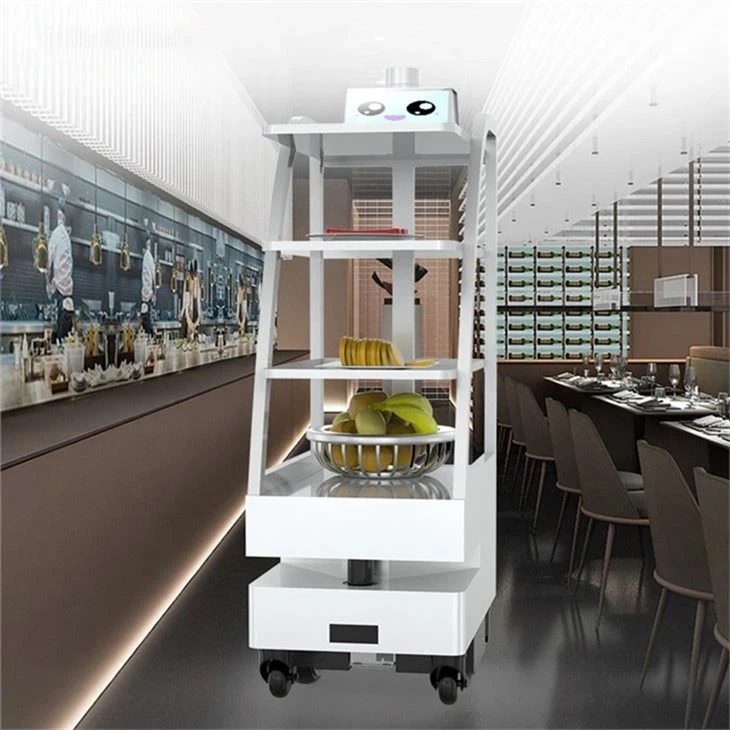

Waitstaff also contribute to the obstacle factor. They are constantly on the move, carrying trays of food and drinks, and may not always be aware of the robot's presence. This can lead to potential collisions if the robot and the waitstaff are not coordinated properly.
Technological Solutions for Navigating Obstacles
To address these challenges, our restaurant waiter robots are equipped with advanced sensors and navigation systems. These technologies enable the robots to detect obstacles accurately and plan their routes accordingly.
One of the key sensors used in our robots is the LiDAR (Light Detection and Ranging) sensor. LiDAR works by emitting laser beams and measuring the time it takes for the light to bounce back from objects. This creates a detailed 3D map of the robot's surroundings, allowing it to identify obstacles with high precision.
In addition to LiDAR, our robots also use cameras and infrared sensors. Cameras can provide visual information about the environment, which is useful for detecting moving objects such as customers and waitstaff. Infrared sensors, on the other hand, are excellent at detecting heat sources, which can help the robot identify the presence of people in the vicinity.
Our robots are also programmed with sophisticated algorithms for path planning. These algorithms take into account the real - time data from the sensors and calculate the most efficient route to the destination while avoiding obstacles. If an obstacle is detected, the robot can quickly adjust its path and find an alternative route.
Testing in Real - World Restaurant Settings
We understand that theoretical capabilities are not enough. That's why we have conducted extensive testing of our robots in real - world restaurant settings. These tests have allowed us to identify and address any issues that may arise in a practical environment.
During the tests, we observed how the robots interacted with different types of obstacles. We found that the LiDAR and camera sensors worked well in detecting fixed and moving obstacles. The robots were able to adjust their paths smoothly when faced with unexpected obstacles, such as customers standing up suddenly.
However, we also encountered some challenges. For example, in very crowded restaurants, the robots sometimes had difficulty finding the most efficient route due to the high density of obstacles. To overcome this, we are continuously improving our path - planning algorithms to handle such complex scenarios more effectively.
Coordination with Human Staff
Another important aspect of making waiter robots work in a restaurant with obstacles is the coordination between the robots and human staff. We have developed a system that allows the waitstaff to communicate with the robots. For example, waitstaff can use a mobile app to send commands to the robot, such as changing the delivery destination or pausing the robot's movement.
This coordination is crucial for ensuring the safety of both the customers and the staff. By working together, the robots and the waitstaff can create a more efficient and harmonious dining environment.
The Future of Restaurant Waiter Robots in Obstacle - Filled Environments
As technology continues to advance, we are confident that restaurant waiter robots will become even more capable of working in environments with a lot of obstacles. Future robots may be equipped with even more advanced sensors and artificial intelligence algorithms that can predict the movements of customers and waitstaff more accurately.
We are also exploring the possibility of using machine learning techniques to improve the robots' ability to adapt to different restaurant layouts and obstacle scenarios. This will enable the robots to learn from their experiences and become more efficient over time.
Conclusion
In conclusion, restaurant waiter robots are indeed capable of working in a restaurant with a lot of obstacles. Through the use of advanced sensors, navigation systems, and coordination with human staff, these robots can overcome the challenges posed by the complex restaurant environment.
If you are a restaurant owner looking to enhance your operations with the latest technology, we invite you to reach out to us. Our team of experts is ready to discuss your specific needs and provide you with the best solutions. Whether you need a Restaurant Delivery Robot, a Restaurant Fast Food Delivery Robot, or a Lightning Food Delivery Robot, we have the right product for you. Let's work together to take your restaurant to the next level.
References
- Smith, J. (2022). The Impact of Automation on the Restaurant Industry. Journal of Hospitality Management.
- Johnson, A. (2023). Technological Advancements in Restaurant Service Robots. International Journal of Food Service Technology.
- Brown, C. (2023). Navigating Obstacles: Challenges and Solutions for Restaurant Service Robots. Robotics and Automation Magazine.


